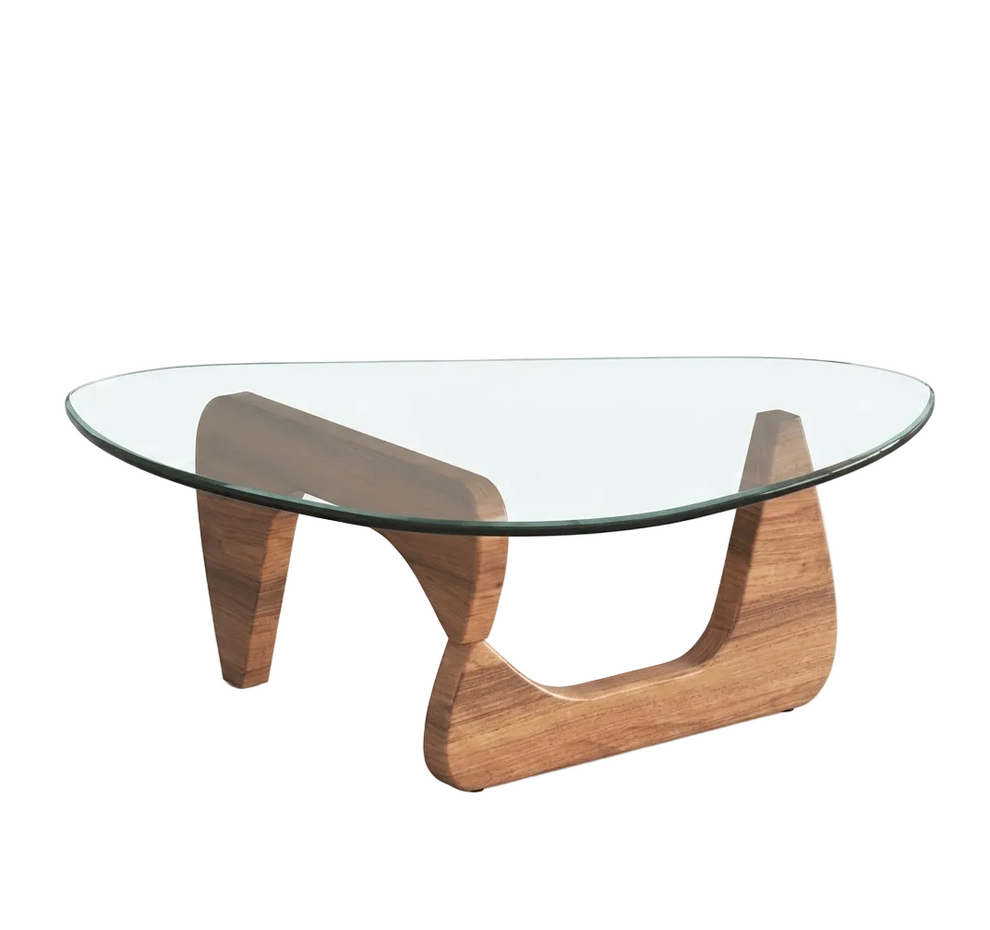
Glass Wood Coffee Table: Why Less Is More for Small and Open Living Spaces
The Material That Disappears

A tempered glass top resting on a solid wood frame — glass doing what it does best: disappearing.
When Glass Became More Than a Material
Wood has always carried warmth.
Steel brought precision.
Leather introduced comfort.
Glass brought something entirely different — space.
Unlike traditional materials that define boundaries, glass allows the surrounding environment to become part of the design. Light passes through. Colors reflect. The room continues uninterrupted.
This was one of the defining ideas behind modernist furniture: the best design does not compete with the space around it — it enhances it.
A glass tabletop performs a simple function, but creates a different experience. You see the architecture beneath it. You notice the chair beside it. The room feels larger, lighter, and more connected.
The material almost disappears — leaving only the form behind.
None of this started as furniture theory. In 1921, entering the competition to design Berlin's first skyscraper on the Friedrichstrasse site, Mies van der Rohe submitted something no architect had proposed before: a tower with no masonry walls at all, just a steel skeleton wrapped entirely in glass. He called the idea "skin and bones" — let the frame carry the weight, and let the skin do almost nothing but let light through. The tower was never built. But the argument it made — that a wall could disappear and a room could still hold together — is the same argument every piece of glass furniture in this collection is quietly making.
"Less is more" — Ludwig Mies van der Rohe
A House With Almost No Walls
Twenty-four years after that first sketch, Mies got to test the idea at full scale. Commissioned in 1945 by Dr. Edith Farnsworth as a weekend retreat outside Chicago, the Farnsworth House has almost no solid exterior wall — just floor-to-ceiling glass held up on eight white steel columns, set into a wooded site by the Fox River. Mies wanted the house to dissolve into its landscape rather than sit apart from it; he later described the goal as bringing nature, the house, and the people living in it into one continuous experience.
It's worth saying plainly: the house was not an easy one to live in. Dr. Farnsworth found it drafty, hard to keep private, and far more expensive to finish than planned — she and Mies eventually fell out over the cost overruns. That tension is the honest part of glass's story in architecture: it delivers on transparency and light in a way nothing else can, but it asks something of the people who live with it in return. A coffee table is a much gentler way to bring that same idea into a room.
Less is more
Mies didn't coin this phrase, and he said so himself. He first heard it around 1907 as a young draftsman for the German industrial architect Peter Behrens, who looked over Mies's facade drawings and said the line to him directly — a warning about restraint, not a slogan. The phrase itself is older still: English poet Robert Browning had used it in an 1855 poem, decades before either architect was born. What Mies added was thirty years of buildings that made the case for it — chrome frame or wood, the principle doesn't change.
Before You Buy: Straight Answers