Mies van der Rohe’s Barcelona Daybed: The Ultimate Leather Classic
The Only Luxury Minimalism Ever Allowed Itself
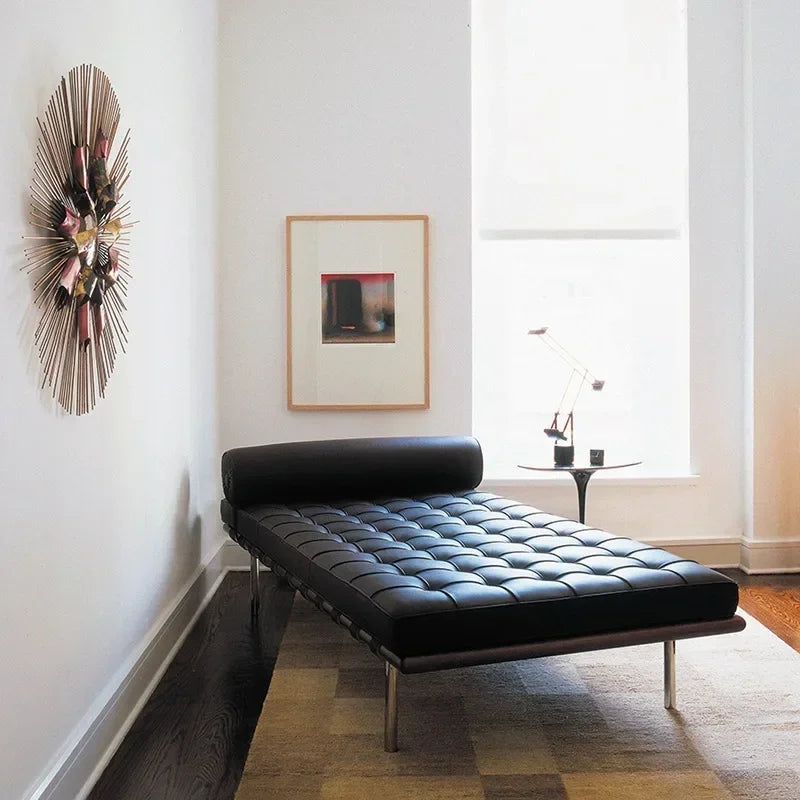
Designed for Royalty: Full-Grain Leather in Modernist Architecture
Mies van der Rohe designed the Barcelona collection for one specific moment: King Alfonso XIII and Queen Victoria Eugenie, visiting the German Pavilion at the 1929 Barcelona International Exposition. Mies later said the seat needed to feel "monumental" — his own word — because, as he put it, "you just couldn't use a kitchen chair" for a king.
He could have used canvas. He could have used a cheaper hide. He didn't. Full-grain leather was the one material minimalism never tried to strip away — because leather does something structure alone can't. It ages. It creases where a body has actually sat. Decades later, a Barcelona piece looks more finished, not less.
The daybed extends that same idea horizontally. Where the chair holds a body upright, the Barcelona Sofa Bed lets the same leather and steel logic stretch out — built for compact, modern living rather than a pavilion, but carrying the same refusal to compromise on material.
"The one material minimalism let grow old in public."
The Designer History Left Off the Credit Line
For most of the last century, the Barcelona collection was filed under one name. That's changing. Lilly Reich, the German designer and Bauhaus master who had been Mies van der Rohe's creative and romantic partner since 1926, was named artistic director of the German contribution to the 1929 Exposition — the role that put her in charge of exactly the kind of interior objects the chair and daybed are. Design historians and Knoll's own archivists now credit her as co-designer, not an assistant.
Why did her name disappear for so long? Partly the era — a woman's design work routinely got absorbed into a male partner's byline in the 1920s and 30s. Partly circumstance — Reich stayed in Germany when Mies emigrated to the US in 1938, and it was Mies's American career, not their shared European one, that built the myth of the solitary genius. The chair itself doesn't care whose name is on it. But it's a more accurate story with both names on it, and a more interesting one.
Why the Chair and the Daybed Don't Share a Frame
People often assume the Barcelona daybed is just the chair stretched out. It isn't — the two pieces solve completely different structural problems, and the material choices prove it.
A chair only has to hold a seated body's weight through one curve. A reclining body distributes weight along its full length, so the daybed needed a rigid deck underneath the leather, not a single sprung frame. That's the quiet difference between something you sit in and something you lie on.
Barcelona Sofa Bed
Designed in 1930 by Mies van der Rohe and Lilly Reich as a companion to the Barcelona Chair, the Sofa Bed translated the collection's architectural grandeur into a daybed format. Its hand-tufted leather cushion rests on a solid wood frame supported by polished tubular steel legs — a pure expression of the Bauhaus philosophy where functional resting meets sculptural form. Knoll acquired exclusive manufacturing rights to the collection directly from Mies in 1953, which is why an original still carries his signature stamped into the base.Before You Buy: Straight Answers